
Astronomy affects people's lives every day in a manner so ordinary most don't even realize it. The simple question, "What day is it?" can be answered by consulting a calendar, but the calendar itself is an artifact that relies on astronomy.
Ancient people, especially in agricultural societies, had to work with multiple components: days, months, seasons, and years. The task of constructing a calendar from these components would have been simple if the elements were coordinated, but they are not. The sequence of equinoxes and solstices that yields the dependable march of the seasons isn't matched to a uniform number of days, and counting cycles of lunar phases requires more than thirty solar years to return to a common starting point.
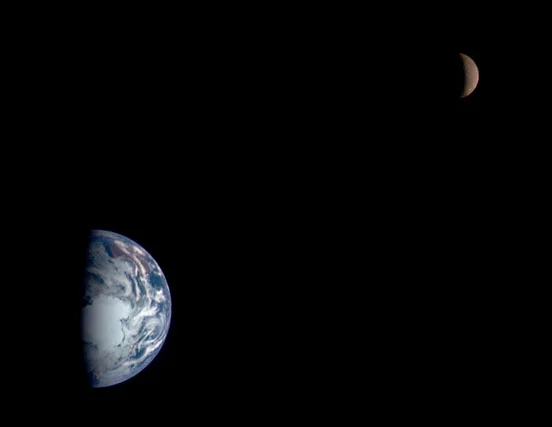
The moon's orbit around Earth is one of the perplexing issues. The moon requires about 27.3 days to travel around the earth and return to a specific position relative to the background of fixed stars (a sidereal month). But, because Earth isn't stationary, the moon needs to travel more than a complete circle to progress through all its phases. The interval between one new moon and the next is about 29.5 days (a synodical month). The fractional days involved in both potential ways of measuring a month make it impossible to define a month by counting an unchanging number of days.
Furthermore, it takes Earth 365.2422 days to make a complete orbit around the sun. Twelve lunar cycles account for 354 days; this is about 11.25 days short of a solar year. As a result, a lunar calendar that doesn't have a mechanism for reconciling itself to the solar cycle, experiences months that drift sequentially through the seasons. The Islamic calendar serves as an example. When compared to the common civil calendar, Islamic dates seem to move backwards by eleven days per year. And, for every 32 common calendar years, the Islamic calendar counts 33 years.
Today's most regularly used civil calendar is the Gregorian calendar, which was introduced in 1582 by Pope Gregory XIII as a reform of the earlier Julian calendar. The Julian calendar takes its name from Julius Caesar, ruler of the Roman Empire during the first century B.C., who sought to bring the months back into alignment with the seasons. A more ancient Roman calendar had ten months of varying lengths with the start of the new year observed on March 1. The move to establish January 1 as the start of a new year occurred sometime before the second century B.C.
One of Pope Gregory's motivations to reform the calendar was to realign the celebration of Easter with its traditional observance in early spring. The Julian calendar assumed a solar year length of 365.25 days. This slight misalignment with the actual solar year accrued a discrepancy of three days every 400 years. Adoption of the more astronomically accurate Gregorian calendar called for a one-time adjustment of ten days and a change in the pattern of adding leap days to centennial years.
So what day is it? You can go outside, observe the stars, record the time, and consult almanacs to calculate the answer. Or you can look at a calendar and thank the astronomers and mathematicians who have already worked it out for you.
The original version of this article, along with a list of additional resources for more information about calendars, appeared in the January 2016 issue of Observations: A Pier Press® Newsletter. You can access the archived issue here, and if you're not already a subscriber, click here to sign up. It's free.